
Asset Value
Use evidence before assumptions harden.
RHIEOS works on the economics and value of clinical development: partner selection, budgets, contracts, payment models, participant burden and the scientific knowledge created along the way.
Partners: what should drive CRO and service-provider selection?
Economics: what range is defensible, and where is uncertainty concentrated?
Contracts: how do terms affect incentives, cost and delivery?
Knowledge ePV™: what can a programme learn even when the asset does not succeed?
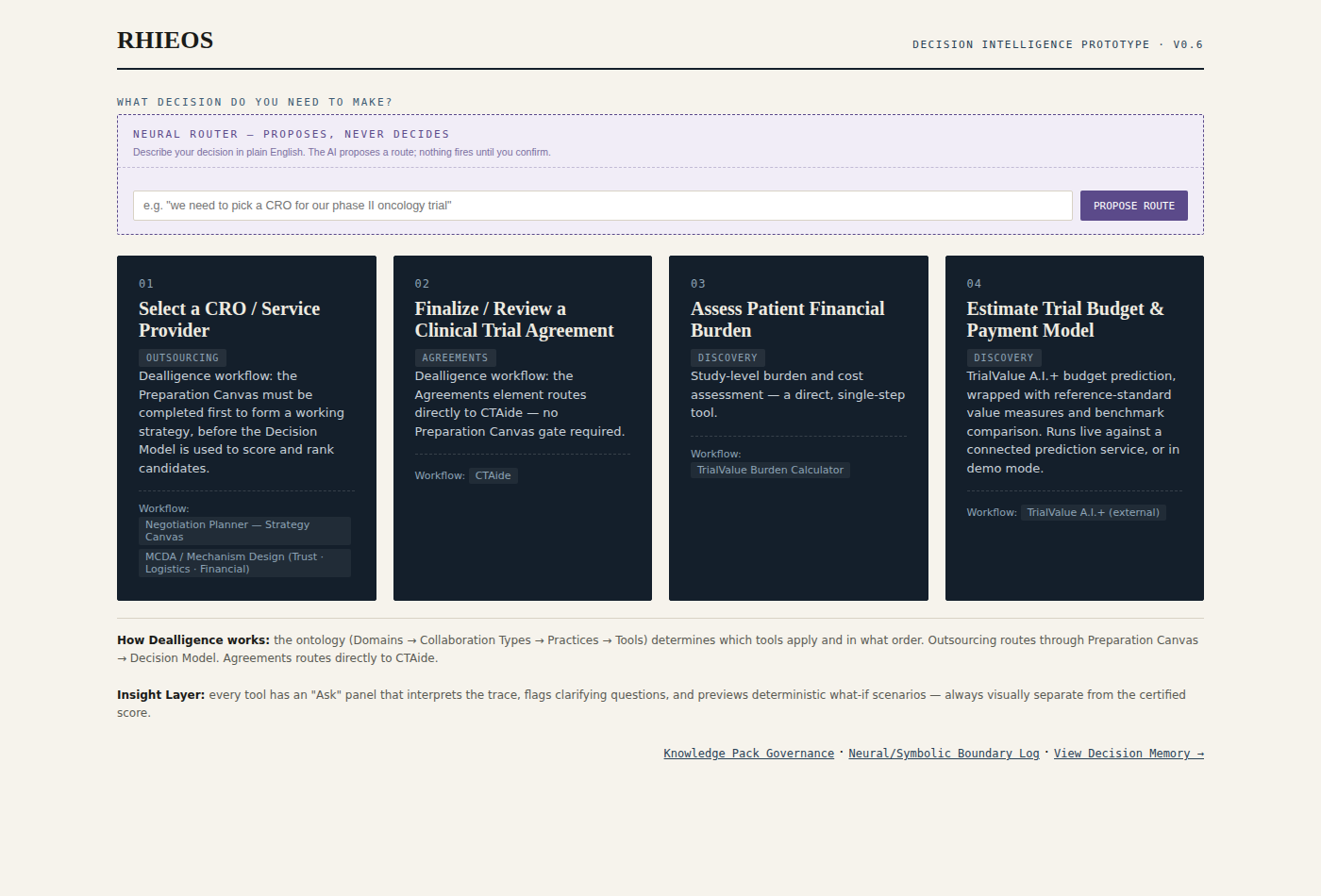
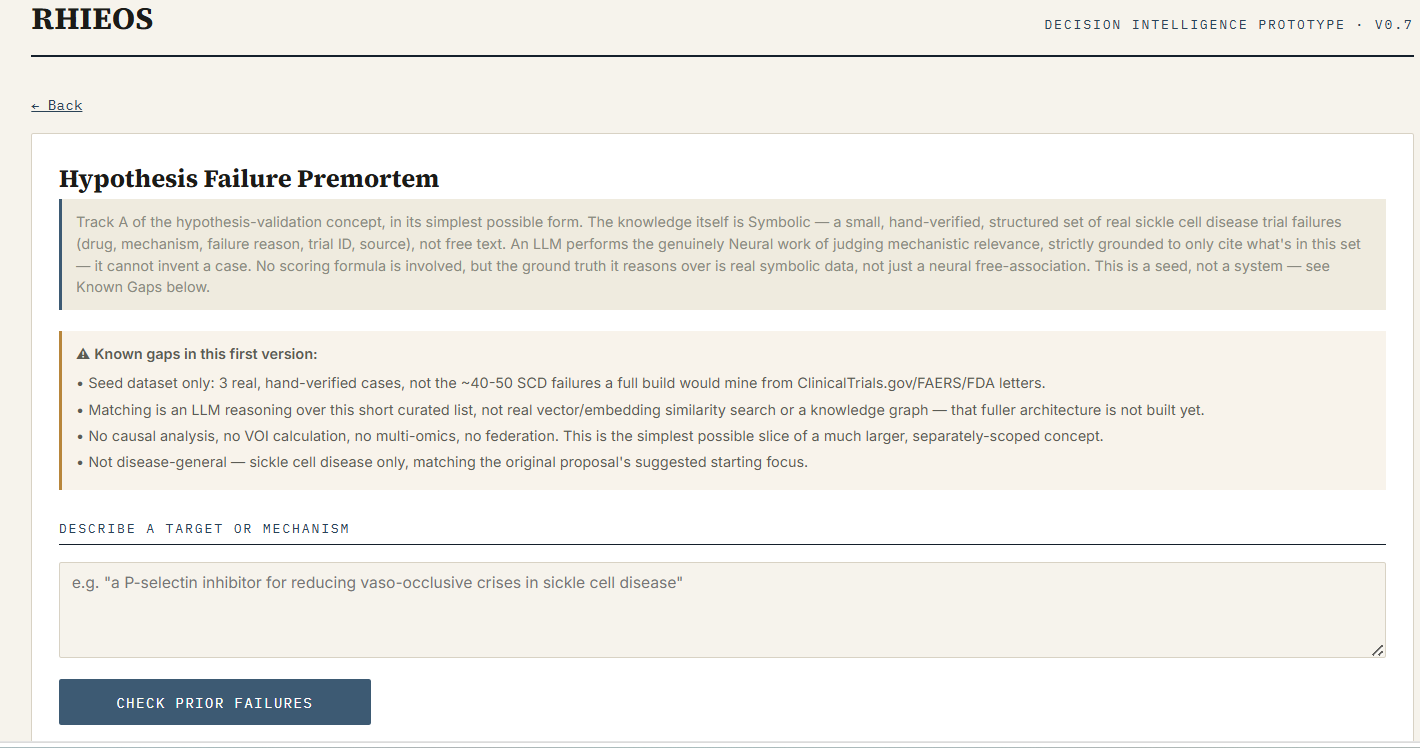
Real working artefacts: clinical-research routing across RHIEOS tools and a deliberately bounded hypothesis-failure prototype.
In practice
Two examples: budgets and selection.
Benchmarking R&D budgets across a global programme
For a global biopharma, RHIEOS built a multi-programme budget prediction and benchmarking model (TrialValue®) spanning 25 studies across Phases I–IV, several regions and therapeutic areas — turning fragmented per-study estimates into one comparable structure.
25Studies benchmarked
I – IVPhases covered
$0.25M – $83MBudget range modelled
Weeks → daysFinancial decision cycle
Learning: once budgets sit on one comparable structure, financial review compresses from a multi-week cycle to days.
Designing incentives for CRO selection
RHIEOS ran a pilot comparing a traditional RFP against a trust-based, mechanism-design multi-criteria approach, run in parallel across four service providers.
Traditional RFP
- Opaque checklist evaluation
- Capability and price dominate
- Hidden risks emerge late
- Longer renegotiation cycle
Trust-based mechanism design
- Criteria configured around incentives and trust
- Evidence normalised and weighted transparently
- Hard filters remove non-viable options early
- Decision logic stays transparent and auditable
12 wks → 2 wksTypical vs pilot decision time
49%Weight placed on trust
≥70%Hard compliance filter
4Service providers engaged
Learning: selection quality improves when decision rules are designed for transparency and early risk exposure.
Request the RfP MCA template →